
Art has always arrived before language. Before doctrine. Before data.
Long before neuroscience mapped neural pathways or psychology named emotional states, humans were marking stone, shaping ritual objects, chanting rhythm, and painting their inner worlds onto cave walls. These acts were not decorative. They were technologies of meaning, connection, and survival.
Today, science is beginning to validate what artists, mystics, and storytellers have always known: art does not simply reflect consciousness. It actively shapes it.
At ROLA, this understanding forms the foundation of our philosophy. Art is not entertainment. It is transmission. A way of moving perception, emotion, and awareness through individuals and across cultures.
The Neuroscience of Storytelling and Emotional Processing
The human brain does not experience stories as information. It experiences them as lived reality.
When we engage with narrative, research shows that multiple brain regions activate at once: language centres, emotional processing systems, memory networks, and sensory regions. Mirror neurons fire, allowing us to internally simulate the experiences of others. The nervous system responds as if the events were happening to us directly.
This is why a film, a piece of music, or a visual artwork can move us faster and deeper than logic ever could. Art bypasses the analytical gatekeeper and speaks directly to emotional and embodied intelligence.
Storytelling becomes a form of emotional rehearsal. It expands our capacity to hold complexity, contradiction, and empathy. Consciousness shifts not through instruction, but through experience.
Sound, Colour, and Pattern as Neurological Stimuli
Every artistic medium communicates with the brain in its own way.
Sound influences brainwave states and nervous system regulation. Rhythm can calm, energise, or destabilise depending on tempo and intention. Certain frequencies support relaxation, focus, or emotional release.
Colour affects mood, perception, and physiological response. Pattern creates coherence or tension. Geometry can ground us, disorient us, or evoke transcendence depending on its structure.
These are not abstract ideas. They are measurable neurological interactions.
When artists intuitively work with light, sound, form, and movement, they are shaping perceptual states. The artwork becomes an experiential field rather than a static object, inviting the viewer into participation rather than observation.
How Creativity Influences the Brain, Emotional States, and Collective Awareness
Creativity is not a passive act. It is a neurological event.
When humans create or deeply engage with art, multiple brain networks come into dialogue. The default mode network associated with self-reflection, the salience network that governs emotional relevance, and sensory processing regions activate simultaneously. This cross-activation supports cognitive flexibility and perspective shifts.
Emotionally, creative engagement regulates the nervous system. It can soften stress responses, surface unprocessed emotion, and restore psychological coherence. This is why art is increasingly recognised as a tool for emotional regulation and integration.
On a collective level, creativity functions as shared cognition. Artistic movements often precede social change because they articulate what societies are feeling before they can articulate what they are becoming. Through shared symbols, images, sounds, and stories, individual insights ripple outward, shaping collective awareness.
Creativity operates on three interconnected levels:
- Neural: rewiring perception and cognitive flexibility
- Emotional: processing experience and restoring balance
- Collective: transmitting meaning across cultures and communities
This is why art has always been a driver of evolution rather than a by-product of it.
Art as a Cross-Cultural Human Connector
Across civilisations, art has served the same essential purpose: helping humans make sense of existence.
Ritual objects, sacred architecture, ancestral music, and ceremonial movement were never isolated cultural expressions. They were shared human responses to universal questions about life, death, belonging, and transformation.
Art collapses distance. It allows people who do not share language or belief systems to recognise something familiar in one another. A rhythm. A symbol. A feeling.
This is why art remains one of the most powerful bridges between cultures. It speaks in a frequency that precedes ideology.
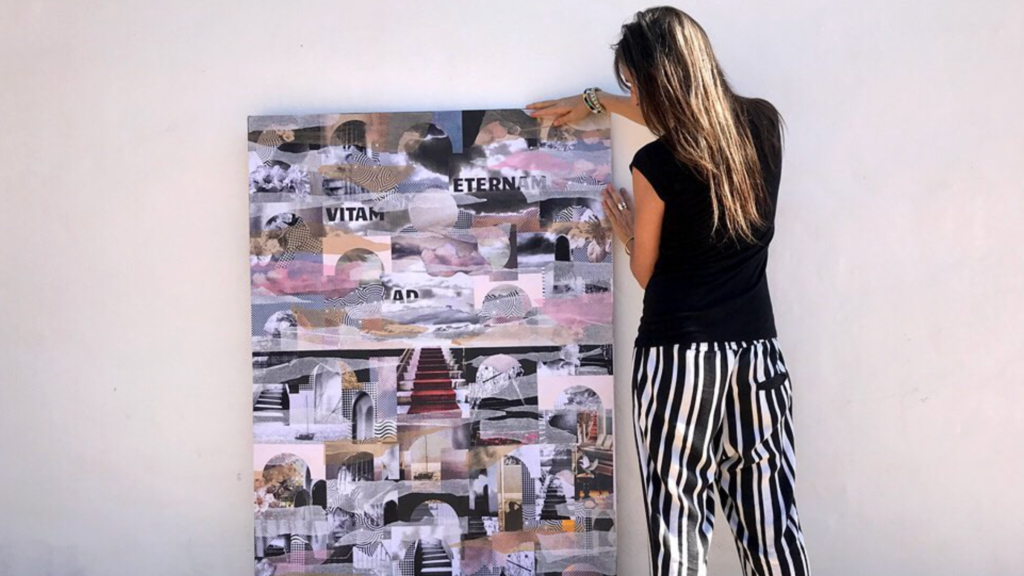
Image via @roselinedethelin
Art as Inquiry: A Contemporary Artistic Perspective
One living example of art as a catalyst for consciousness can be found in the interdisciplinary practice of Roseline de Thélin, an Ibiza-based visual artist, expressive arts practitioner, and founder of Art Lab Ibiza.
Her work sits at the intersection of visual art, psychology, embodiment, and perception. Rather than treating art as a finished object, Roseline approaches it as a process of inquiry, where making becomes a way of thinking, sensing, and shifting awareness.
Light plays a central role in her artistic language. Through sculptural installations and hybrid media, she explores how light carries information, alters perception, and shapes our understanding of time, space, and reality. In this context, light is both material and metaphor: a bridge between the visible and invisible, the inner and outer worlds.
“Roseline de Thélin has spent more than 30 years exploring the connections between creativity and consciousness”. – Nativ Ibiza
Grounded in expressive arts, art therapy, and consciousness studies, her practice views creativity as a tool for integration and transformation. Artistic expression becomes a means of expanding self-awareness, processing emotional experience, and inviting perspective shifts that ripple beyond the individual.
Here, art functions simultaneously as mirror and method. It reflects inner states while actively reshaping them, demonstrating how creativity can influence perception, emotional regulation, and conscious evolution. Art functions as both mirror and method: reflecting inner states while actively reshaping them.
Ibiza as a Container for Conscious Art
Ibiza has long functioned as more than a geographic location. The island has acted as a cultural and energetic meeting point where art, ritual, nature, and experimentation intersect. Its history of migration, counterculture, spiritual inquiry, and creative freedom has made it a fertile ground for artistic practices that explore perception, embodiment, and expanded awareness. Here, art does not exist in isolation from landscape or community. It emerges in dialogue with land, light, rhythm, and collective presence, allowing works rooted in consciousness to feel both grounded and expansive.
Sculpture, Space, and Cosmic Orientation
Another powerful illustration of art’s relationship with consciousness can be found in the monumental sculpture Time and Space, created by sculptor Andrew Rogers on the western edge of Ibiza.
Set within a dramatic coastal landscape, the installation uses scale, geometry, and alignment to shift perception. Composed of towering stone forms arranged according to mathematical and cosmological principles, the work evokes ancient human impulses to mark time, honour celestial order, and situate human life within a greater cosmic rhythm.
“Andrew Rogers’ Time & Space sculpture (otherwise known as ‘Ibiza Henge’) – a spectacular 13-pillar monument made from imported basalt. The tallest column reaches 10m high and is capped in 23-carat-gold that’s designed to capture the sun’s rays throughout the day, with perfect alignment on the summer and winter solstices.” – White Ibiza
The experience of Time and Space is not primarily intellectual. It is embodied. The size of the stones alters spatial awareness, stillness invites reflection, and the surrounding landscape becomes inseparable from the artwork itself.
Such encounters often evoke awe, humility, and a sense of connection that feels both deeply personal and collectively shared. In this way, sculpture becomes more than form. It becomes orientation: a reminder of humanity’s relationship to nature, time, and the vastness beyond the self. In these moments, art moves beyond interpretation and becomes orientation: a reminder of our place within something larger.
Why This Matters to ROLA
ROLA exists to hold space for art that alters frequency, invites awareness, and opens perceptual doors.
We are drawn to work that engages consciousness rather than merely decorating experience. Film, music, visual art, and storytelling are not separate disciplines to us. They are different dialects of the same human language.
In a world driven by speed, certainty, and fragmentation, art remains one of the few forces capable of slowing us down enough to feel, reflect, and reconnect.
Art does not simply respond to consciousness.
It evolves it.
Stay Connected
- Ray of Light Awards – Instagram
https://www.instagram.com/rayoflightawards - Subscribe to The Light Letter.